CM Punjab bike scheme registration is done online on the official portal, bikes.punjab.gov.pk. This guide walks you through each step: creating your account, the documents, the Phase 2 eligibility rules, and what happens after you apply.
As of 15 September 2026, registration for Phase 2 is open, and the portal shows 4 October 2026 as the last date. Phase 2 offers 100,000 electric bikes on interest-free installments, and registration is free. For the full scheme overview, see our main guide on the CM Punjab Electric Bike Scheme.
CM Punjab bike scheme registration: step by step
You register only on the official portal, bikes.punjab.gov.pk. The Punjab government’s own scheme page is punjab.gov.pk/cm-ebikes-scheme. These are the steps shown on the portal in September 2026:
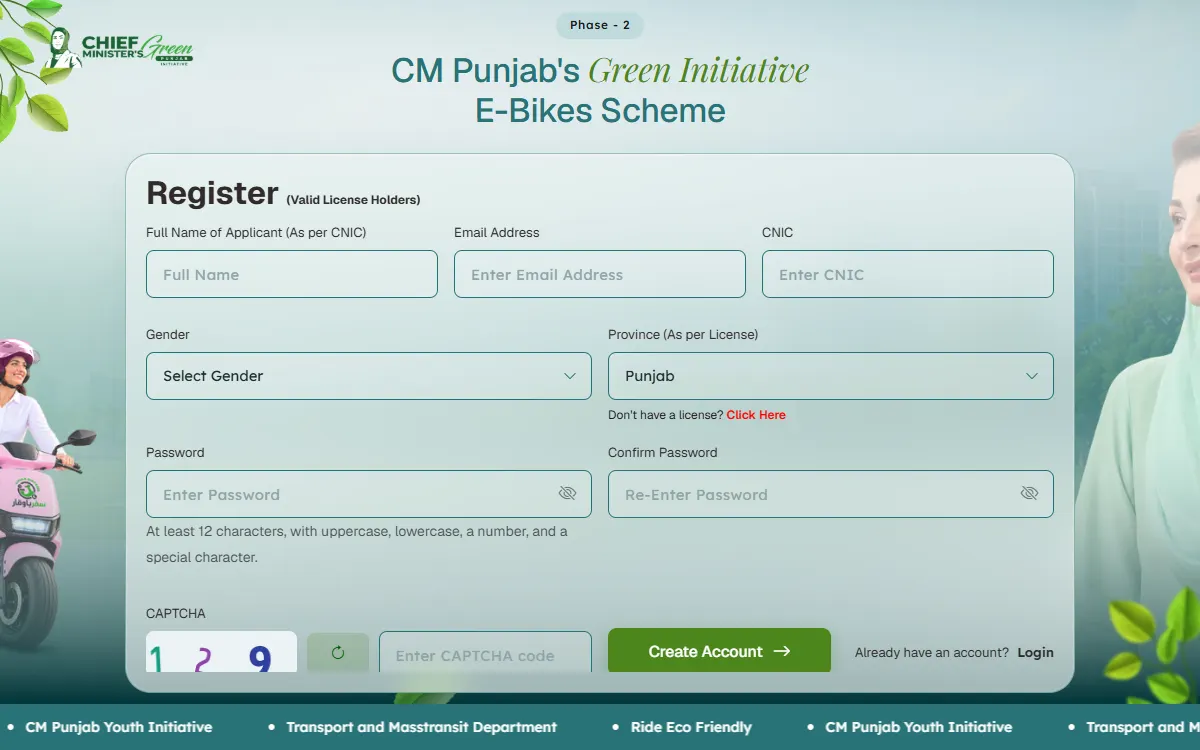
- Open the portal and click Apply Now. This opens the Register page, which is for applicants who already hold a valid licence or permit.
- Enter your full name as on your CNIC, your email address, your CNIC number, your gender as on your CNIC, and the province that issued your licence.
- Choose a password of at least 12 characters, with a capital letter, a small letter, a number and a symbol. Fill the captcha and click Create Account.
- Log in with your CNIC and password.
- Fill the application form, add your documents, and submit.
After you submit, the portal lists four more stages: documentation, verification of your details and eligibility, approval and financing, and bike delivery. If you forget your password, the login page has a Forgot Password link.
If you do not have a licence yet
The Register page has a Don’t have a license? link, which opens the Maryam Ki Dastak services page. Get your licence or permit first, then register.
- Age 16 or 17: get a juvenile driving permit first. Go to your nearest driving licence office (a traffic police licensing centre) with your father or guardian. The note on the Register page says this, and the Punjab Traffic Police website also tells people aged 16 to 18 to visit their nearest licensing centre for this permit. (The FAQ on the portal’s home page says “Sahulat Center” instead, so if in doubt, start at the licensing centre.) News reports say that since July 2026 you can also apply at any e-Khidmat Markaz. You need a B-Form or smart card and written consent from a parent or guardian, and you must pass a sign test and a road test.
- Age 18 or older: apply for a learner’s permit. See our guide on the driving licence online in Punjab.
- Same-day licences: In September 2026, Punjab traffic police said e-bike applicants can get a learner’s permit and a regular licence on the same day, without the usual 42-day wait.
Who is eligible
For Phase 2, the official portal lists these rules (as of September 2026). You must:
- Be at least 16 years old on the day you apply
- Be a bonafide student of a public or private educational institution that is registered or recognised by the Punjab government
- Hold a valid driving licence, learner’s permit or juvenile driving permit
- Have a valid CNIC, B-Form or Child Registration Certificate (CRC)
- Have a guarantor with a regular, verifiable income of at least Rs 40,000 a month
Students of federally chartered institutes, including their campuses, cannot apply. A Punjab government press release of 10 September 2026 also says only one student per family can get an e-bike.
Why other guides show different rules
Many websites, and an earlier version of this guide, list the Phase 1 (2024) rules: 18 or older, a regular student of an HEC-recognised degree college or university, a learner’s permit or licence, and a Punjab domicile. The same wording also appeared in a government press release on 10 September 2026. The Phase 2 portal, where you actually apply, lists the wider rules above. If you are not sure you qualify, read the eligibility section on the portal before you register.
Documents you need
Keep clear scans or photos ready before you register. The portal lists:
- Your CNIC, B-Form or CRC
- Your driving licence, learner’s permit or juvenile permit
- Your student card, or a letter or certificate from your institution confirming you are a student
- Your latest paid fee slip from your institution
- Your guarantor’s CNIC
- Your guarantor’s recent bank statement and proof of income
- A mobile number registered in your guarantor’s name, or in your own name if you have a documented income
About the guarantor
Every applicant needs a guarantor, because you repay the bike over 3 years. The portal says a parent or legal guardian can be your guarantor. Its detailed rules say the guarantor can be anyone whose income is acceptable under the bank’s rules. The portal shows the Bank of Punjab as a partner.
Your guarantor must have:
- A valid CNIC
- A regular, verifiable income of at least Rs 40,000 a month
- A recent bank statement
- A mobile SIM registered in their own name against their CNIC
What the bike costs
As of September 2026, the portal lists the e-bike price as Rs 199,000. The Punjab government pays a Rs 90,000 subsidy, so your share works out to Rs 109,000. There is no down payment and no interest. The portal’s home page shows a monthly installment of about Rs 3,000 for 3 years.
Some news reports give Rs 3,028 a month. That is simply Rs 109,000 divided by 36 months, not a figure published on the portal, and the exact amount is confirmed at the approval and financing stage. The government also pays insurance, registration and token tax. The portal lists a free helmet and safety rod, and the Punjab government’s scheme page adds free two-day riding training. Confirm these terms on the portal, because amounts can change.
How selection works (e-balloting)
More than 432,000 students registered in the first two days, according to a government press release, for 100,000 bikes. As of 15 September 2026:
- The Phase 2 portal has not announced a selection or ballot method. It lists verification, then approval and financing.
- The overview on the Punjab government’s scheme page, which still describes Phase 1, says that when applications exceed the quota, an e-ballot based on domicile district is held. That was the Phase 1 method, and the Phase 1 e-ballot was held on 11 May 2024. The page’s newer Phase 2 section does not mention a ballot.
- Registering does not guarantee a bike in this phase.
- No one can add your name to a ballot or list. Anyone who asks for money to guarantee selection is a fraud.
Keep checking the official portal for updates, not social media posts.
After you apply
Once your application is verified and your financing is approved, the bike is delivered. The Chief Minister directed officials to deliver bikes to eligible students within six weeks. Free two-day riding training is part of the scheme, and in September 2026 Lahore traffic police opened five scooter training schools, including one at Liberty Khidmat Markaz.
Stay safe from fraud
- Register only on bikes.punjab.gov.pk. Copycat websites with “scheme” or “e-bike” in their name are not the government.
- Registration is free, and nobody can add your name for money. Never pay to “register” or “confirm” a bike.
- Never share your OTP or password with anyone, including someone who says they are from the scheme or a bank.
- If someone demands money, report it on the Pakistan Citizen’s Portal.
Contact
- Portal: bikes.punjab.gov.pk
- Email: support@bikes.punjab.gov.pk. This is the support contact shown on the portal, and the best way to reach the scheme.
- Phone: As of 15 September 2026, the Phase 2 portal does not show a helpline number. Numbers on other websites may belong to Phase 1 in 2024 or to other services, so do not rely on them.
Related guides
- CM Punjab Electric Bike Scheme, our main guide to the scheme
- Driving licence online in Punjab, for your learner’s permit
- Maryam Ki Dastak, government services at your door
- CM Punjab Laptop Scheme, another program for students
To see what else may fit you, try our free eligibility checker.
GoPunjab is an independent information website. We are not the Transport and Mass Transit Department, PITB or the Bank of Punjab. We cannot register you or select you for a bike. We only explain how the official process works so you can apply correctly.