The Rehmat Card, officially the CM Punjab Rahmat Card, is a Punjab government grant for Zakat-eligible widows and parentless orphans. This guide explains who qualifies, how much is paid, the documents you need, and how to apply.
The official portal is rahmatcard.punjab.gov.pk and the helpline is 1077.
What the Rehmat Card is
It is described officially as a specialised social safety net providing financial security to widows and orphans across Punjab.
Unlike a monthly stipend such as Benazir Kafaalat, this is a substantial one-time grant aimed at households that lost their earning member. It is administered through the Zakat and Ushr Department, which is why the eligibility rules follow Zakat criteria rather than ordinary welfare criteria.
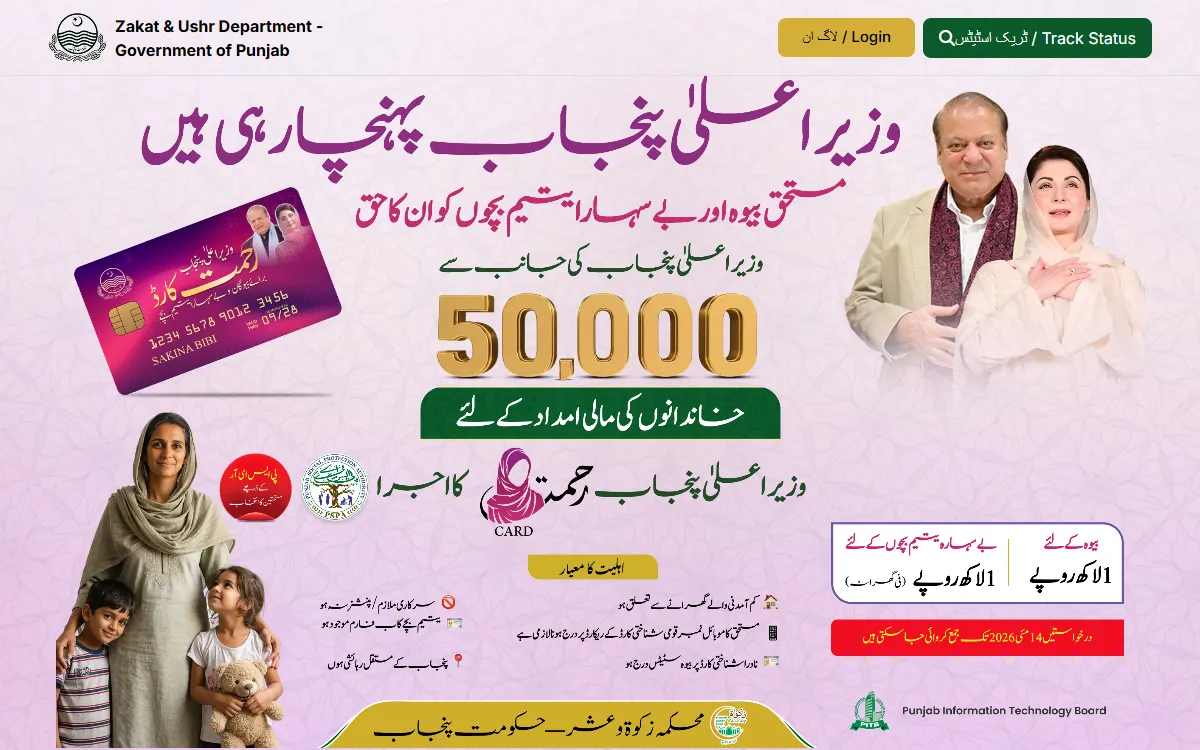
Under its first phase the programme targets 50,000 families, with a budget allocation of Rs 5 billion.
How much is paid
Official sources state the following amounts:
| Who | Reported amount |
|---|---|
| Widow | Rs 100,000 |
| Orphan child (in a widow’s family) | Rs 25,000 each, up to Rs 150,000 per family |
| Double parent orphan (parentless child) | Rs 100,000 per child |
Note that a child who has lost both parents is treated differently from a child in a widow’s household, which is why two different figures appear. Amounts are set by government and can change, so treat these as accurate as of 2026 and confirm on 1077.
Who is eligible
To qualify you must be:
- A needy Muslim widow, or a parentless orphan
- Eligible to receive Zakat under Shariah
- Living below the poverty line
- A resident of Punjab
Who is not eligible
The exclusions are specific, and worth reading before you apply:
- Habitual beggars
- Government servants
- Pensioners
- Sahib-e-Nisab, meaning those who own wealth above the Zakat threshold
- People already receiving regular financial assistance from other provincial government schemes
That last exclusion matters. If you already receive a regular Punjab government stipend, you may be outside this programme by design.
Documents you need
- A valid CNIC that reflects widow status
- A B-Form for each orphan child
This is where most applications fail. Verification runs against the NADRA database. If your husband has died but your NADRA record still shows you as married, the system does not see you as a widow, and the application will not succeed no matter how genuine your situation is.
Update your NADRA record first. Our NADRA CNIC guide explains how, and you will need the death certificate. Our death certificate guide covers that step.
How to apply
You have four official routes:
- The official portal, rahmatcard.punjab.gov.pk
- The dedicated mobile application
- Your local Zakat and Ushr office
- The helpline 1077
For many widows the Zakat and Ushr office is the most practical route, since staff can check documents in person. The helpline is the right first call if you are unsure whether you qualify.
How selection works
Applying does not guarantee approval. Selection is merit-based, using:
- The Punjab Socio-Economic Registry (PSER) database
- The Proxy Means Test (PMT) poverty score
- NADRA verification of identity and widow status
This makes your PSER record directly relevant. If your household was never surveyed, or the record still lists your late husband as an earning member, that works against you. See our PSER registration guide and PMT score guide.
How payment reaches you
Payment is biometric-enabled, released through Bank of Punjab and JazzCash to a bank account or digital wallet.
Biometric means you must be physically present with your fingerprints and CNIC. That is a protection: it stops anyone else collecting on your behalf. It also means nobody can legitimately offer to collect the money for you.
Protect yourself from fraud
Widows are a frequent target for fraud, so be firm about these:
- Applying is free. There is no registration fee.
- No agent can add your name to the list or speed up approval.
- Never share an OTP, including with someone claiming to be from the Zakat office or a bank.
- Payment requires your own biometric verification. Nobody can collect it for you.
- Only rahmatcard.punjab.gov.pk is the official portal.
If someone demands money, report it through the Pakistan Citizen’s Portal, or call 1077.
After you apply
You can track your application online. Our Rehmat Card check online guide walks through the status page and explains what each result means.
Applying on someone else’s behalf
Many Rehmat Card applications are completed by a son, daughter or neighbour, because the widow herself may not use the internet or may find offices difficult. If that is you:
- Start with the NADRA record. Nothing else works until widow status is registered.
- Use her CNIC, not yours, when applying and when checking status later.
- Write down the reference number. She will need it and is unlikely to be given anything else in writing.
- Never take her OTP, even to help. You can assist without ever handling a code.
- She must collect the payment herself. Disbursement is biometric, so plan for her to be present rather than expecting to collect on her behalf.
Other support for widows and orphan families
A widowed household often qualifies for several programmes at once, and they are separate applications:
- Benazir Kafaalat, the federal quarterly stipend
- Benazir Taleemi Wazaif, education stipends for children
- Zewar-e-Taleem, for girls in covered districts
- Sehat Card, for hospital treatment
- Punjab Women Helpline 1043, for free legal advice
- All PSPA programs
To see which Punjab and federal programmes your household may qualify for, try our free eligibility checker.
GoPunjab is an independent information website. We are not the Zakat and Ushr Department, cannot register you, approve an application, or release a payment. We only explain how the official process works.