The BISP ineligible reason behind a “not eligible” reply on 8171 is almost always in your household’s record in the NSER, BISP’s national survey registry. The reply does not tell you the exact reason, and no website can show it to you. But BISP’s own pages explain the rules it applies, and there is a free way to get your record looked at again. This guide covers the ineligible message only. For who qualifies in the first place, read our BISP eligibility check guide.
BISP ineligible reason: 3 steps to take first
- Check the result again at 8171.bisp.gov.pk or by sending your 13-digit CNIC, without dashes, to 8171. Make sure it says not eligible, and not “CNIC not found”.
- Match it to a reason in the table below. For most families it is the PMT score, or old household data.
- Go to the Benazir Registration Desk in your nearest BISP Tehsil office with your original CNIC to update your data, or call the free BISP helpline 0800-26477 to ask about your case.
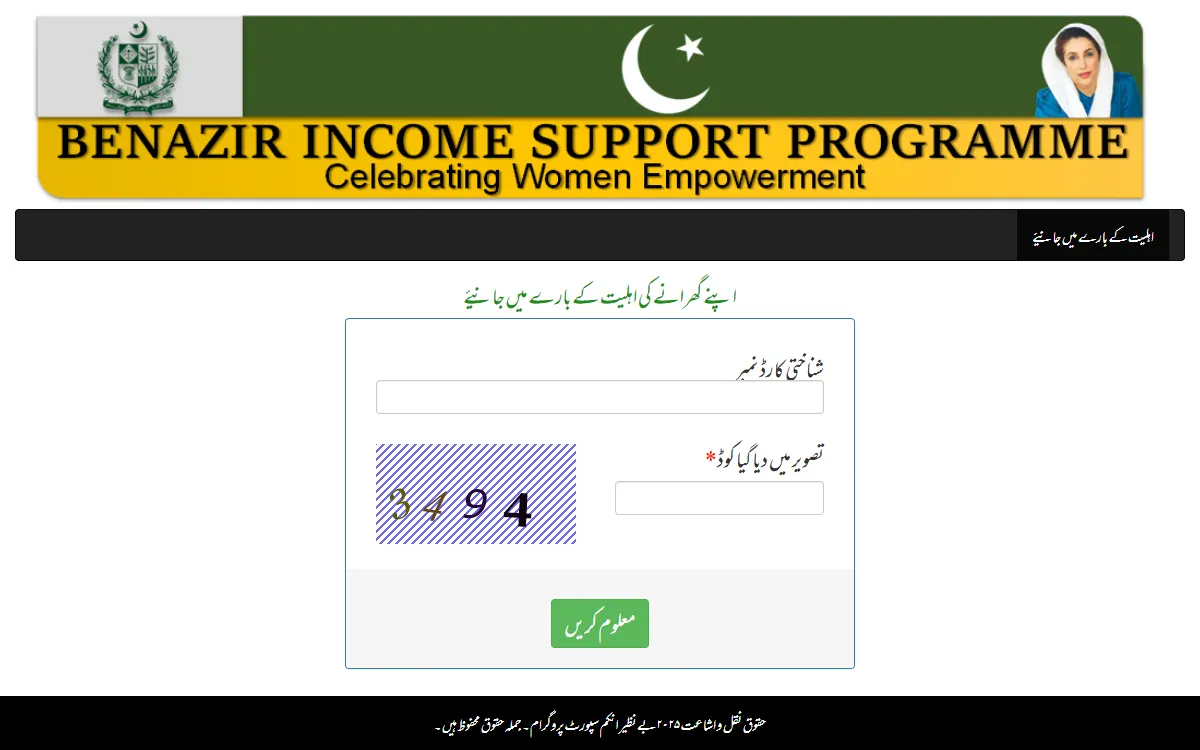
What the 8171 “not eligible” message means
There are two different replies that people often confuse:
| 8171 reply | What it means | What to do |
|---|---|---|
| Not eligible | Your household is in the NSER, but the current record does not qualify | Find the reason below, then update your data if your situation has changed |
| CNIC not found | Your household has never been surveyed | Register through the NSER survey. See our BISP registration guide |
If you were getting Kafaalat and it stopped, read our BISP payment not received guide as well. It covers the payment side.
The official reasons BISP gives
As of September 2026, these are the reasons BISP publishes, or that BISP and the government have stated in the news.
1. Your PMT score is above the cut-off
This is the main reason. BISP gives every surveyed household a Proxy Means Test (PMT) score from 0 to 100, worked out from the survey answers. A lower score means greater need. BISP’s Kafaalat page says the BISP Board set the cut-off at 32 in September 2021. For a family with a person with a disability, it is 37. Above that, your household is not eligible for Kafaalat.
BISP does not publish your own score. Our PMT score check guide explains what the score is built from.
2. Exclusion filters for better-off households
BISP’s NSER page says it uses “exclusion filters (such as vehicle ownership, frequent air travel, etc.)” to profile possible beneficiaries. So a household can be excluded even when its survey answers look poor.
In December 2019, BISP removed 820,165 people from Kafaalat using NADRA data. The News reported the filters used then:
- one or more foreign trips, by the woman or her husband
- a vehicle registered to her or her husband
- an average phone bill (PTCL or mobile) above Rs 1,000 a month over six months
- a passport made at an executive centre, or CNICs made with an executive fee for three or more family members
- government employment, including the husband’s
BISP has not published its full current list. In April 2022, the federal minister for poverty alleviation said many of those 2019 removals were made without verification, and Radio Pakistan reported that 8171 was opened to review those cases.
3. A government employee in the household
BISP support is not meant for government employees. The 2019 profiling removed employees of the federal, provincial and area governments, Pakistan Post, Pakistan Railways and BISP itself, and also women whose husbands worked there.
4. Your household record is old or wrong
The NSER survey data was mostly collected between 2019 and 2021. If your family has changed since then, the record may no longer show your real situation. For example, a disability that was never recorded means the higher cut-off of 37 is not applied to you. BISP also checks names, CNICs, marital status, gender and disability status against NADRA’s records, so a wrong NADRA record can also count against you.
How to get your data updated or resurveyed
BISP set up Benazir Registration Desks at every Tehsil office to register missed households and update the data of households already surveyed. To use one:
- Fix your NADRA record first. Make sure your CNIC shows your current marital status. Our NADRA CNIC guide explains how. If someone in the family has died, get the Union Council death certificate so NADRA can update the record.
- Take your documents: your original CNIC, the CNICs of adult household members, B-Forms for all children, and a working mobile number. Take a disability certificate if a member has a disability.
- Give true answers. The officer asks about your household, education, assets and income. False answers can cause problems later.
- Check 8171 again later. Your eligibility is re-assessed from the updated data. It is not instant.
Be realistic about timing. BISP’s NSER page says updates to family members, such as births, deaths, marital status and disability, are regular. A full resurvey of your living conditions is allowed only periodically, except after a disaster. The same page says non-beneficiaries are to be called for a resurvey every two years. So ask the desk staff what kind of update your case needs. Our what is NSER guide explains the registry in more detail.
How to complain or appeal
BISP’s Kafaalat page says it runs a Grievance Redressal Mechanism. To lodge a complaint:
- Visit your nearest BISP Tehsil office with your original CNIC.
- Or call the toll free BISP helpline 0800-26477. BISP’s website lists it as open Monday to Friday, 9am to 5pm.
- Keep the complaint number or the name of the officer you spoke to.
If you believe a filter was applied wrongly, for example a single trip or a phone bill that does not reflect how your family lives, say so clearly and ask how to have your case reviewed. If nothing moves, you can also complain about the federal department on the Pakistan Citizen’s Portal.
Widows and divorced women
BISP’s published criteria give widows and divorced women no separate cut-off. The same PMT rule applies. What helps is a correct record: update your marital status with NADRA, then update your household at the registration desk.
What not to do
- Do not pay an agent. Nobody can raise or lower your PMT score, or “add your name”, for money. The update at the Tehsil office is free.
- Do not trust other numbers or sites. Only 8171 and 8171.bisp.gov.pk are official for checking.
- Do not share an OTP or PIN with anyone, even someone who says they are BISP staff.
- Do not keep sending SMS and waiting for the answer to change. The answer changes only when your record changes.
- Do not hide assets. Give true answers in the survey.
If someone asks for money or codes in BISP’s name, report it on 0800-26477 or at your Tehsil office. For a wider view of Punjab and federal support you may still qualify for, try our free eligibility checker, and read BISP vs PSER to see why Punjab schemes use a separate survey.
GoPunjab is an independent website. We are not BISP. We cannot see your record, tell you your PMT score, or change your result. We only explain the official process so you can follow it yourself.