The Sila-e-Fun program pays a monthly allowance to elderly and financially struggling artists in Punjab. This guide explains who qualifies, what the three criteria are, and how it differs from Punjab’s other welfare programs.
It is run by the Punjab Social Protection Authority (PSPA), and the name means “reward for art”.
The problem the Sila-e-Fun program addresses
A working life in the arts in Pakistan rarely comes with a pension, provident fund, or any retirement provision.
A musician who played for decades, a poet published across a lifetime, a theatre actor known to a whole generation, a journalist who covered forty years of events: many reach their seventies with no savings and no institutional support. Recognition does not pay rent.
PSPA describes the purpose as improving the socio-economic wellbeing of the elderly and financially vulnerable artists of the Punjab who have made a notable contribution in their field.
Who is eligible
Three criteria, all required together:
| Criterion | Requirement |
|---|---|
| Age | 50 years and above |
| Monthly income | Below Rs 35,000 |
| Experience | Minimum 25 years in the field |
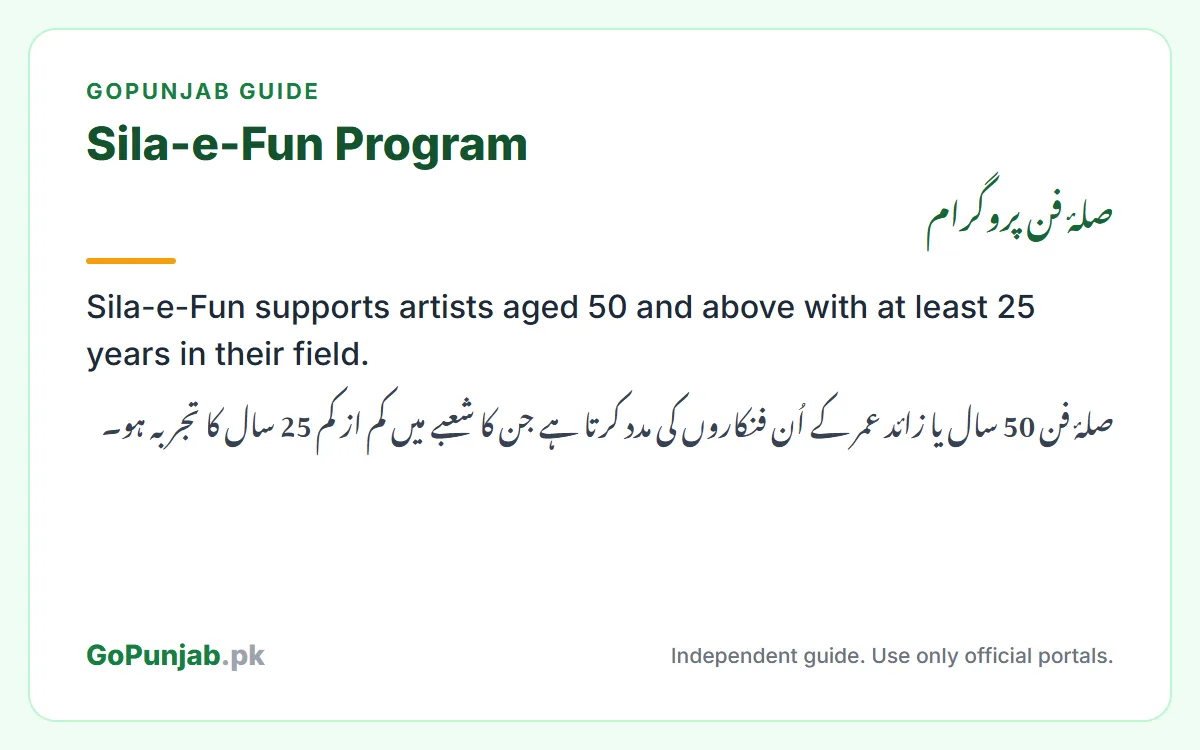
The 25-year requirement is what defines the programme. This is aimed at people who gave their working life to the field, not at emerging artists needing a start.
Note also that the income ceiling and the experience floor work together. A long career alone is not enough if you are earning comfortably; low income alone is not enough without the career behind it.
Which fields count
The program covers artists, writers, poets and media persons across:
- Film
- Television
- Literature
- Poetry
- Journalism
- Theatre
- Music
- Painting
The common thread is a notable contribution to the field. That is not the same as fame or commercial success. A folk musician who played at gatherings across a district for forty years has a notable contribution, even without a recording contract.
How much is paid
Rs 5,000 per month, as an unconditional cash transfer.
“Unconditional” is a meaningful distinction here. Punjab’s other programs attach ongoing conditions: Aaghosh requires health check-ups, and Zewar-e-Taleem requires school attendance. Sila-e-Fun does not. Once you qualify, there is no monthly hoop to clear.
Amounts are policy decisions and can change. Treat this as accurate as of 2026 and confirm the current figure with PSPA.
Where it operates
The program runs in all 36 districts of Punjab.
This is worth highlighting because several PSPA programs are limited to selected low-income districts, which excludes most applicants who ask about them. Sila-e-Fun is not. An artist in any Punjab district who meets the criteria can be considered.
How to apply
PSPA does not publish an open online application form for this program, so the route is direct contact.
Practical steps:
- Confirm you meet all three criteria: age, income, and 25 years of experience.
- Gather evidence of your career. This is the part worth preparing properly.
- Contact PSPA on the helpline 1221, or on 042-99231758, or by email at info@pspa.punjab.gov.pk.
- Ask about the process in your district, since local arrangements differ.
PSPA has also worked with the Information and Culture Department on this program, so that department may be a useful second point of contact.
Evidence of your career
Proving 25 years in a field is harder for artists than for salaried workers, because there is often no employment record. Gather whatever exists:
- Published work: books, articles, bylines, recordings
- Programme listings, posters, or playbills naming you
- Press coverage or reviews mentioning your work
- Membership of arts councils, press clubs, or professional associations
- Certificates, awards, or honours
- Letters from institutions you worked with, such as a theatre, radio station, or newspaper
Older artists often have this material scattered across family homes and rarely in one file. Assembling it is usually the longest part of the process, so start there rather than leaving it until asked.
If you are applying on behalf of an older artist
Many of the artists this program is designed for will never apply themselves. They may not know it exists, may not use the internet, and may be reluctant to present themselves as needing help.
If you are a family member, a student, or a fellow artist helping someone apply:
- Assemble the evidence first. This is the real work, and it is easier for you than for them.
- Be specific about the years. “Since the early 1980s” is stronger than “a long time”.
- Ask their peers. Arts councils, press clubs and theatre groups often hold records the artist does not.
- Handle the calls. A helpline conversation is a barrier for many older people.
- Never pass on an OTP, even when helping.
Dignity matters here. Many older artists find it hard to ask. Framing it as a reward for contribution, which is what the program’s name says, is closer to the truth than treating it as charity.
Registration is free
- There is no fee to apply.
- No agent can arrange your inclusion.
- Never share an OTP with anyone, including someone claiming to be from PSPA.
- Payments come through official channels.
Report demands for money through the Pakistan Citizen’s Portal.
Contact
- Website: pspa.punjab.gov.pk
- Social protection helpline: 1221
- Phone: 042-99231758
- Email: info@pspa.punjab.gov.pk
If you do not qualify
The 25-year requirement rules out many artists. Other options:
- Ba-Himmat Buzurg, PSPA’s pension for poor elderly people aged 65 and above; ask PSPA on 1221 whether new names are being added
- Humqadam if you have a disability
- Sehat Card for hospital treatment
- Benazir Kafaalat on the federal side
- All PSPA programs
If you know an older artist who might qualify, tell them. Many are not aware this program exists, and it is the kind of thing that spreads by word of mouth rather than through official notices.
To see which Punjab and federal programs your household may qualify for, try our free eligibility checker.
GoPunjab is an independent information website. We are not PSPA, cannot enrol you, assess your eligibility, or release a payment. We only explain how the official process works.