A succession certificate NADRA issues lets the legal heirs of a person who has died claim the money and property left behind, without filing a case in court. NADRA (National Database and Registration Authority) checks the heirs against its Family Registration Certificate (FRC) record, publishes a public notice, and then issues the certificate. This guide covers the Punjab process as of October 2026: who applies, the documents, the fee and the timeline.
We know this is a hard time for a family. The steps below are kept as short as the rules allow.
Succession certificate NADRA in 3 steps
- Get the papers ready. You need the death certificate, the NADRA CNIC cancellation certificate, the FRC, CNIC copies of every legal heir, the asset documents and a letter of authorisation signed by the heirs.
- Apply at a Succession Facilitation Unit. One legal heir visits a NADRA office that runs a Succession Facilitation Unit (SFU) and pays the fee. All heirs then give biometric verification.
- Wait for the notice period. NADRA publishes a notice in the newspaper. If nobody objects within 14 days, NADRA prints the certificate.
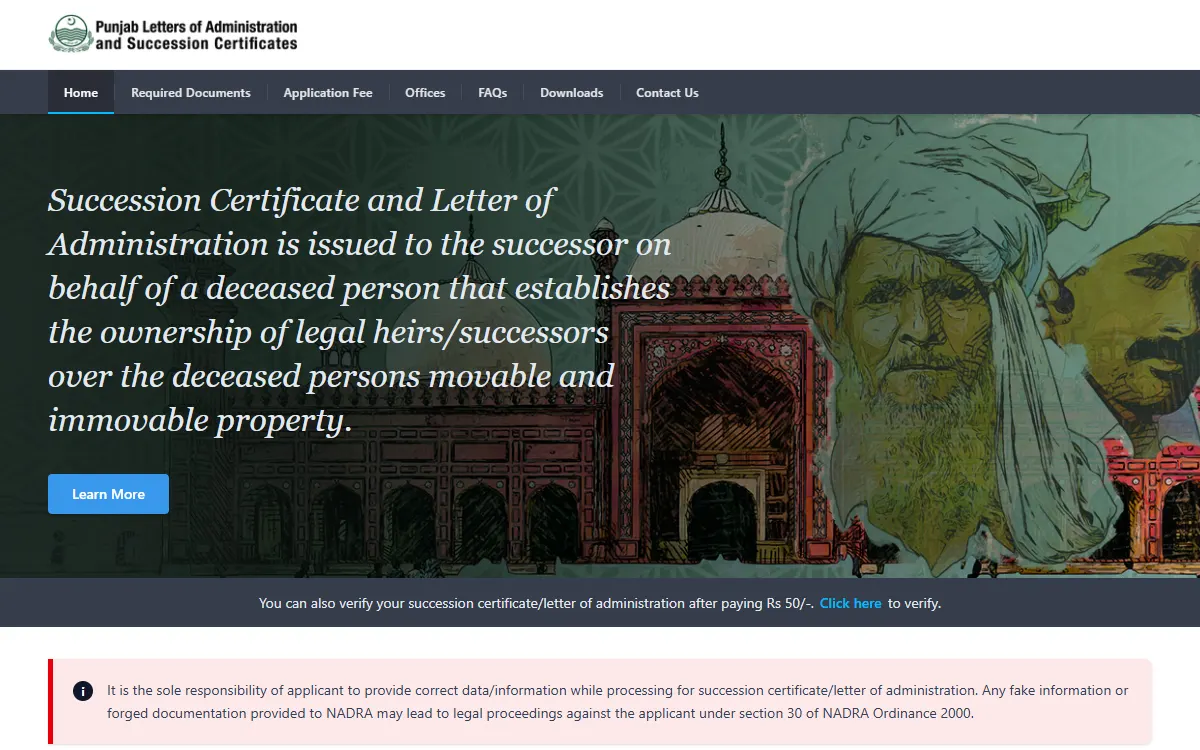
Succession Certificate or Letter of Administration?
NADRA issues two documents, and you may need both:
| Document | What it covers | Examples |
|---|---|---|
| Succession Certificate | Movable assets | Bank accounts, lockers, cash, prize bonds, National Savings certificates, shares, insurance claims |
| Letter of Administration | Immovable property | A house, plot, shop or land |
The certificate names all the legal heirs and their shares. NADRA says it works these out under the personal law of the person who died, even when there was a nomination or an unregistered will.
The law behind it
Before 2021, heirs had to go to a civil court under the Succession Act 1925. Punjab passed the Punjab Letters of Administration and Succession Certificates Act 2021, and the Prime Minister launched the NADRA service for Punjab in July 2021, Dawn reported. NADRA’s legal framework page lists the Punjab Act (May 2021) and the Punjab Rules (June 2021) beside the federal Act of 2020.
The law lets NADRA notify its own offices as Succession Facilitation Units. As of October 2026, NADRA’s footprint page lists 42 succession centres in Punjab. For the current list, see the Offices page on NADRA’s Punjab succession portal.
Who can apply
NADRA’s rules on eligibility are short:
- The deceased and all legal heirs must be Pakistani citizens.
- The property or assets must be inside Pakistan.
- One legal heir applies, with a letter of authorisation from all the other heirs. This consent form is in Schedule I of the law. NADRA says it can be on plain paper, stamped and signed by an Oath Commissioner.
In August 2025, NADRA said heirs could apply at any of its 186 SFUs across Pakistan, not only in the province where the property is, APP reported. NADRA’s main website now says “any designated site in Pakistan” too. The Punjab portal’s own FAQ still describes provincial jurisdiction, so ask at the counter if your case crosses provinces.
Documents you need
NADRA’s Punjab portal lists:
- CNIC, NICOP or POC of the applicant
- CNIC copies of all other legal heirs
- Card cancellation of the deceased, and of any legal heir who has also died
- FRC Alpha (by birth) and FRC Beta (by marriage)
- Original documents of each movable and immovable asset
- Affidavit or letter of authorisation, as in Schedule I
NADRA can ask for more evidence if it needs to. Two of these papers come from earlier steps:
- The death certificate comes from the Union Council. Our death certificate guide explains how to get it, and how NADRA then cancels the CNIC for free.
- The FRC shows the heirs as NADRA has recorded them. If a child, spouse or parent is missing, fix the record first. Our NADRA FRC guide shows how.
The five-step NADRA process
NADRA’s Punjab portal describes it like this:
- Application. The applicant gives their own CNIC number and the deceased person’s death certificate and CNIC number.
- Heirs and assets. The applicant gives details of every legal heir and every asset.
- Biometric consent. Every legal heir named in the application gives biometric verification. NADRA said in August 2025 that heirs can do this at a NADRA centre or in the Pak ID mobile app.
- Newspaper notice. NADRA publishes a public notice in the newspaper inviting objections.
- Printing. If no person or organisation objects within 14 days of the notice, the certificate is printed and given to the applicant.
NADRA’s main website gives the processing time as 14 days after publication. The Punjab portal’s FAQ says about 15 working days after the advertisement. Either way, the time starts only after every heir has completed biometrics and the notice is out.
NADRA does not hand a copy to every heir. The applicant receives it. The certificate is digital and has a real-time verification facility. The Punjab portal offers online verification of a certificate for Rs 50.
The fee
As of October 2026, NADRA’s fee structure page and the Punjab portal list:
| Application | Assets worth Rs 100,000 or more | Assets worth less than Rs 100,000 |
|---|---|---|
| New application | Rs 20,000 | Rs 10,000 |
| Duplicate | Rs 5,000 | Rs 5,000 |
| Amended (modification or reprint of a lost certificate) | Rs 5,000 | Rs 5,000 |
| Office mistake | Free | Free |
The Rs 22,000 figure on NADRA’s fee page applies to Sindh, not Punjab. A decline certificate, for estates that NADRA cannot process, is listed at Rs 15,000 for assets of Rs 100,000 or more. NADRA’s pages disagree on the fee for smaller estates, so ask at the counter. Fees can change. Pay only at the NADRA counter and keep the receipt.
When the case goes to court
NADRA’s process works when the family agrees. It does not settle disputes.
- Someone objects after the newspaper notice, or an heir does not give consent. The matter then goes to a civil court.
- NADRA declines the case. It issues a decline certificate, so you can go to court. NADRA’s FAQ gives one example: heirs with property in several provinces who do not want to use NADRA.
- You choose the court. In May 2026, Dawn reported that Punjab’s law now lets both NADRA and civil courts issue these certificates. A court follows the procedure of the Succession Act 1925.
Hiding a legal heir is a serious matter. NADRA warns that fake information or forged papers can lead to action under section 30 of the NADRA Ordinance 2000. The certificate can also be revoked.
After you get the certificate
- Bank accounts and savings: take the Succession Certificate to the bank or National Savings branch.
- Land: take the Letter of Administration to the land record office for the inheritance mutation. Our Punjab land record guide explains the Fard and the Arazi Record Centres.
- Pensions: survivor pensions follow their own rules, for example the EOBI pension.
Stay safe from fraud
- Apply only at a NADRA SFU. Check the details on nadra.gov.pk or punjabsuccession.nadra.gov.pk.
- NADRA says it does not offer services on WhatsApp or social media, and does not authorise agents.
- Pay only the official fee at the counter. No one can “skip” the newspaper notice for money.
- Never share an OTP or your Pak ID password. Families are often targeted after a death.
- Report bribe requests on the Pakistan Citizen’s Portal.
Contact NADRA
- Helpline: 1777 from a mobile, or 051-111-786-100
- Succession email: scp@nadra.gov.pk
- Punjab portal: punjabsuccession.nadra.gov.pk
If your own CNIC needs an update first, see our NADRA CNIC online guide.
GoPunjab is an independent website. We are not NADRA or a court. We cannot issue a succession certificate, see your records or give legal advice. We only explain how the official process works.